OVERVIEW
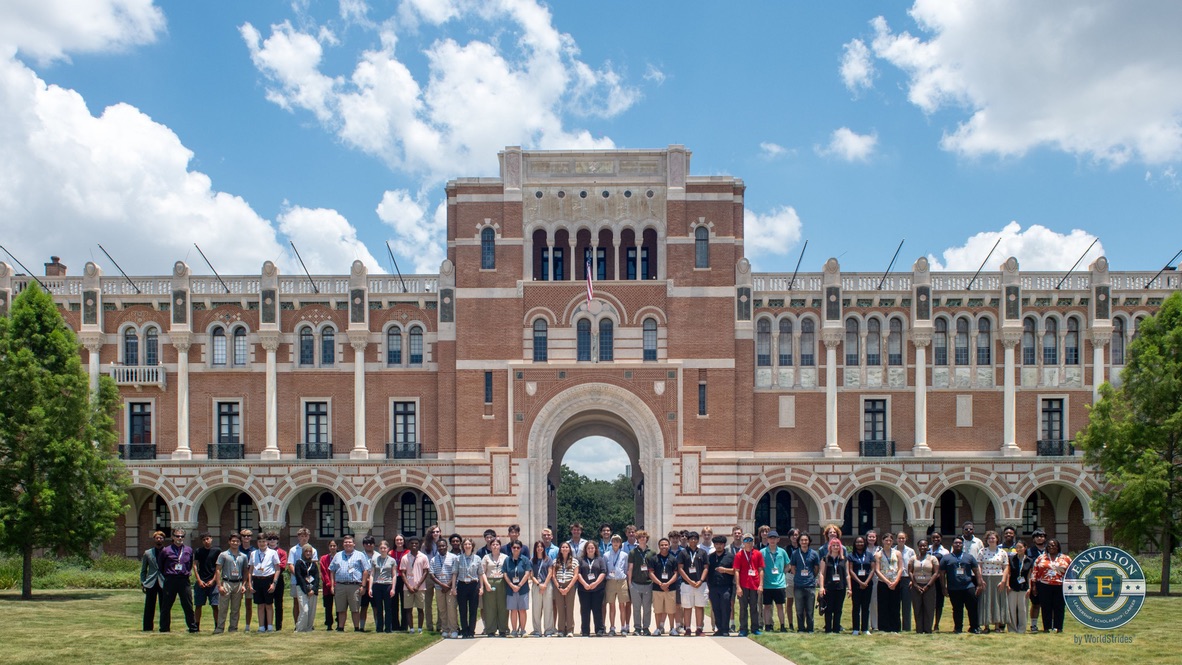
Think about what it actually takes to put something into the sky. Not the highlight reel — the countdown, the smoke, the cheering — but everything underneath it: the math that says the fins are big enough, the checklist that says the payload is sealed, the person who has to sign off knowing that in about four seconds, everyone is going to find out whether they were right. Earlier this month, I spent a week living inside that process at the Envision Aerospace Engineering Camp, held on the Rice University campus in Houston.
That’s the whole appeal. Aerospace looks like magic from the outside, but up close it’s a discipline — a long chain of small, careful decisions where every link has to hold. For one week, we got to forge some of those links ourselves: designing and launching rockets, sending instruments toward the edge of the sky, and learning the engineering that makes any of it possible. This is what that week looked like.
The Rocket Challenge
One of the main events of the camp was the Rocket Challenge, and it worked the way real engineering works: you don’t get to just build the thing; you have to continuously innovate and improve it. Every design decision — the shape of the nose cone, the size and placement of the fins, the weight you’re willing to carry — is a trade-off, and neither the sky nor the judges grade on effort. A rocket that looks perfect on the table can flip through the air the moment it leaves the launchpad, and the only way to find out is through trial and error.
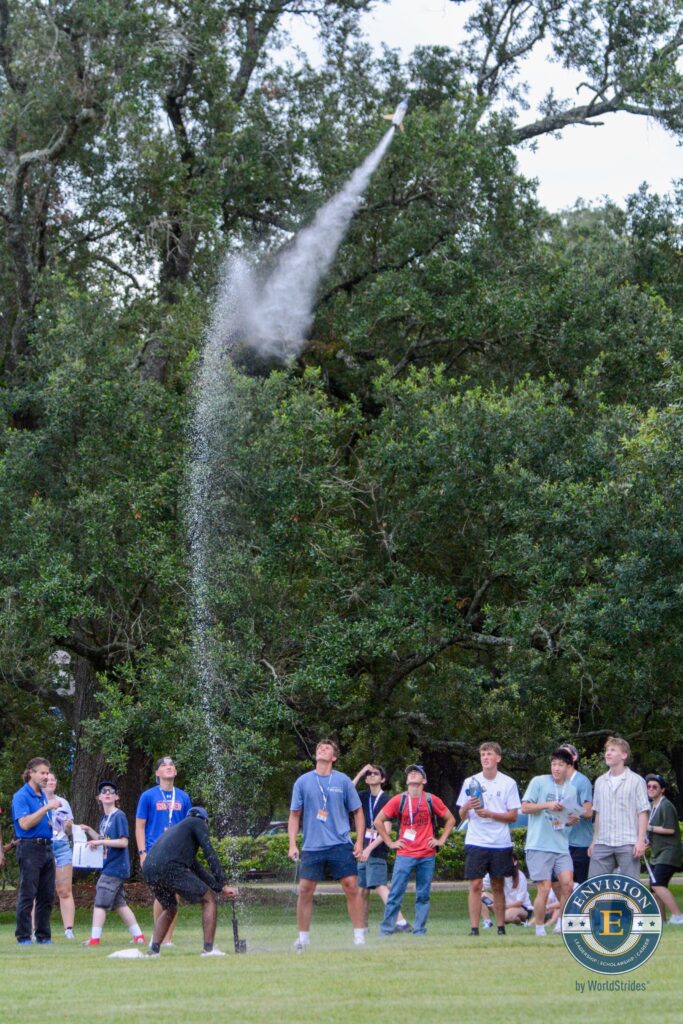
Our rocket was no exception to this process as we encountered plenty of failure before we found our high-flying design. For context, these rockets were water bottle rockets that launched using water and high air pressure inside the bottle. Our team began with a very simple setup: a 2-liter bottle with cardboard fins and a paper nose cone. While we weren’t super confident that this was the best design, it was a good starting point to find how to improve. We took our rocket out for the first launch only to watch ot spin through the air three times and go about 20 feet in the air. While disappointing, it was helpful to see how our rocket failed so we could improve those weak points. I was able to figure out that the spinning was due to the paper nosecone being uneven and very easy to deform. To solve this issue, I 3D modeled and then printed a new nosecone that would fit the bottle perfectly and hopefully be strong enough to withstand running into the ground. I considered making 3D-printed fins but found that the cardboard fins were both stronger and easier to replace if they broke. With that, our final design was ready for the final competition later that day. We started with an elimination round where only the top three rockets would be taken into the Finals. We were the second group to go, so we didn’t know what the rest of the competition would look like going forward, but we were very confident our rocket would prevail. We set up our rocket on the launchpad, which was pretty much a rod with a bicycle pump going into it, and filled it up to 120 PSI with 450 mL of water. All that was left was for me to pull the trigger, and when I did, the rocket flew higher than I ever could have imagined, staying in the air for well over 5 seconds. We found similar success with our launch in the finals, and it was even enough for us to win the entire competition. It felt great to win even though I’m not big into aerospace engineering as a whole.
Micro:bit Weather Balloon Project
The Rocket Challenge was about thrust; the weather balloon project was about data. In collaboration with Space Center Houston, NASA’s visitor center, we programmed micro:bit microcontrollers — small, credit-card-sized computers — to serve as the instrument package for a high-altitude weather balloon, logging conditions as the balloon climbed through the atmosphere. It’s a completely different kind of engineering from our previous rocket challenge, relying more on longevity and consistency than on the fragile yet efficient design of the rockets. Each team would have to use a micro:bit controller to collect different kinds of data; our group decided to collect data on the strength of Earth’s magnetic field as you moved farther from its core. I was given the job to code and wire the Micro:bit so it would correctly collect and relay data.
What stuck with me is how much of the work happens before anything leaves the ground. A sensor that isn’t calibrated, code that crashes at the wrong moment, a connection that shakes loose — any one of them and you get nothing back but silence. In an attempt to avoid this fate, I made sure everything was coded correctly and wired in tight so sudden changes wouldn’t ruin our entire experiment. After around 2 days of work, we headed to MSR Houston racetrack early in the morning to launch our payloads up in the weather balloon. It’s been about 4 days since launch, and we’re waiting to hear back from Space Center Houston about the details
Classroom Studies
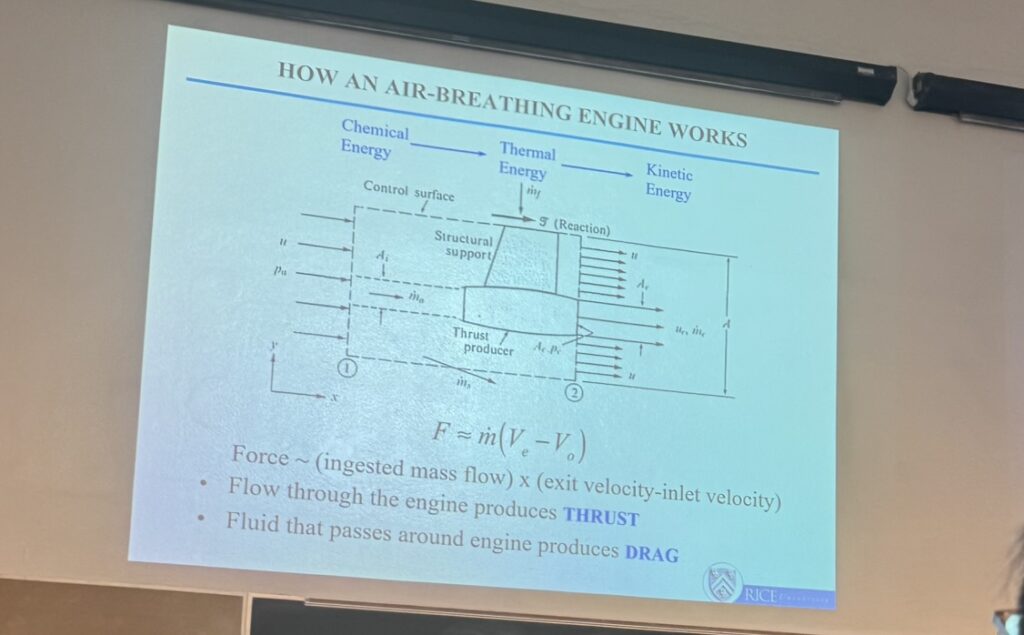
Between the launches and the builds, we spent real time in the classroom, and this is the part of the camp that’s easy to forget about. The hands-on projects are the exciting things everyone likes to talk about, but the classroom is where the real magic happens. We dug into the principles underneath everything we were building and other facets of aerospace engineering, including aerodynamics, propulsion, Orbits, Satellites, etc.
The sessions were taught with actual engineering practice in mind, not just theory for its own sake, and were taught by masters in their fields. Some were retired astronauts; others were esteemed NASA engineers and professors. No matter who was teaching, it was clear that they had passion for their profession, something I hope to find with civil engineering in the future. By the end of the week, I found myself looking at the projects differently. It was easier to make assumptions about what was working and what needed to be fixed each time I encountered a problem. Though I likely won’t find a future in aerospace engineering, it was still an extremely educational experience for how to think and build like an engineer does.
Campus Life
All of this happened on the campus of Rice University, and living there for almost 2 weeks was an experience of its own. There’s something about staying in the dorms, eating in the dining halls, and walking to sessions across an actual college campus that makes the whole thing feel less like summer camp and more like a preview for what college life will be like in a few years. I found how easy it was to make connections in a new place; it got me really excited for what kind of people I would meet and what kind of experiences I would have once I got into college
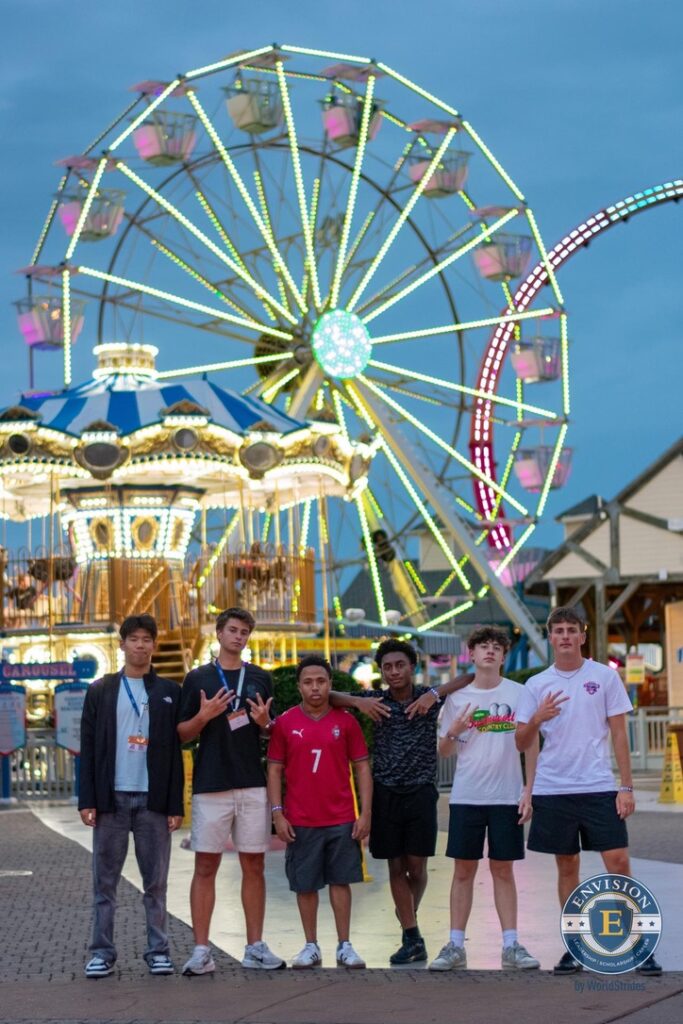
The other half of campus life was the people. Everyone there had chosen to spend part of their summer doing engineering, which means you’re surrounded by people who get excited about the same things you do. By the end of the day, I had already found a group of 15 or so guys that would go on to become my good friends for the rest of camp. I only had three of them in my team, so I spent the most time with them while I was able to see the rest during Meals, Rec time, and dorm time. Surprisingly, ping pong became one of the group’s favorite pastimes; if I had to guess, we probably played over 150 matches of ping pong over those two weeks, whether it was at a normal table or a makeshift one in the dorms made of a wooden coffee table and stacked books. Those guys made the time fly by a lot faster than I expected it to and made even the most boring moments something worth remembering
CONCLUSION
Here’s what it comes down to: 2 weeks is not very long, but it’s long enough to find out whether something fits. I went into this camp not necessarily interested in aerospace engineering, but as a way to hone my engineering mind and rule out aerospace as a potential career. Even still, I came out of it with a trophy from the Rocket Challenge, data from the edge of the sky, and something more useful than either: a real sense of what this work actually feels like from the inside.
The rockets came down. The balloon will come down. What didn’t come down is the way I look at the field now. Every aircraft overhead, every launch clip online, is a chain of small, careful decisions made by people who had to be right. Not even just for aerospace, every field of engineering holds the same attention to detail and meticulous work when it comes to the work that comes out of it. For two weeks at Rice, I got to be one of the people. I intend to be one again.