OVERVIEW
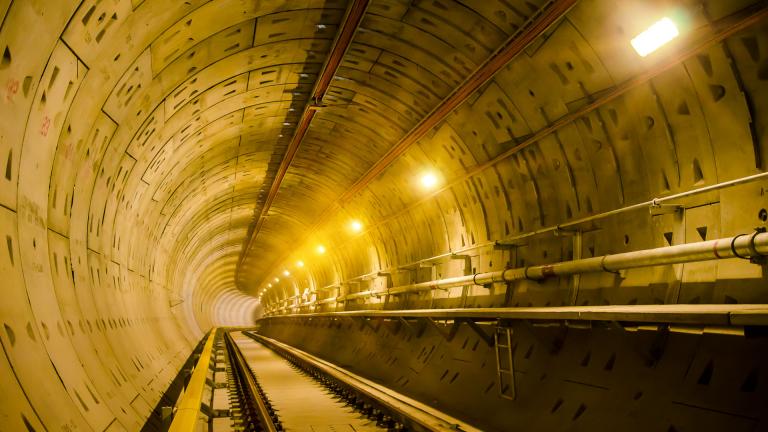
Think about the last time you drove through a tunnel. Maybe it was a quick underpass beneath a river, or one of those long mountain bores where your radio cuts out, the temperature drops a couple of degrees, and you instinctively check that your headlights are on. You probably noticed the tiled walls, the strange orange glow, the way sound changes the instant you’re surrounded by rock on every side. What you almost certainly didn’t think about was the thousands of tons of earth pressing down above your roof, the water trying to force its way through the walls, or the fact that someone had to convince a mountain to stay exactly where it was while they hollowed out a hole the length of a marathon.
That’s the whole trick. When a tunnel is built right, the most remarkable thing about it is how unremarkable it feels.
But tunnels are some of the hardest things civil engineers ever attempt, and for a reason that’s easy to miss. With a bridge or a building, you can see your opponent: gravity, wind, the load you’re holding up. With a tunnel, the structure is the ground — and the ground is the one material an engineer never gets to fully inspect before committing to it. You can drill, you can sample, you can model, but until the machine is actually grinding through it, you’re making an educated guess about millions of tons of rock and soil you’ll never lay eyes on.
The people who pull this off don’t get statues. Nobody names the tunnel after the geotechnical engineer who worked out how deep the soft clay ran. But every time you come out the far end into daylight — on time, and completely dry — you’re trusting their math.
Digging The Hole
First, You Have to Know What’s Down There
Long before any machine shows up, engineers are trying to answer one question: what is this ground actually made of? They drill boreholes — sometimes dozens of them — pulling up core samples along the planned route to build a picture of what’s waiting underground. Solid, consistent rock is the dream. The nightmare is a mixed face, where the machine has to cut through hard rock and soft, waterlogged soil at the same time, each demanding a completely different approach.
This investigation drives every decision that follows. Soft, water-saturated ground near a river calls for one kind of machine and relentless pressure control. Hard alpine granite calls for another. And because no number of boreholes can map every fault, seam, and trapped pocket of water along miles of route, engineers end up planning for the gaps in their own knowledge. Good tunneling is, in large part, the discipline of preparing for the rock you didn’t expect.
Four Ways to Make a Hole
There isn’t one way to dig a tunnel — there are several, and choosing wrong gets expensive fast.
Cut-and-cover is the bluntest: dig a big trench down from the surface, build the tunnel inside it, then bury it back over. It’s cheap and straightforward, which is why so many older subway lines were built this way. But it tears up everything on the surface while you do it, so in a dense modern city it’s a logistical headache.
Drill-and-blast is exactly what it sounds like, and it’s still the standard in hard rock. Crews drill a pattern of holes into the rock face, pack them with explosives, detonate, clear the rubble, and repeat. It’s slow and loud, but it handles brutal geology and odd shapes that a machine simply can’t.
Immersed tube is how you cross a wide river or harbor: prefabricate giant tunnel sections on land, float them out, and sink them into a trench dredged in the riverbed, joining them underwater like a chain of train cars. The BART Transbay Tube under San Francisco Bay was built this way.
And then there’s the tunnel boring machine, which earns its own section.
The Machine That Builds the Tunnel Around Itself
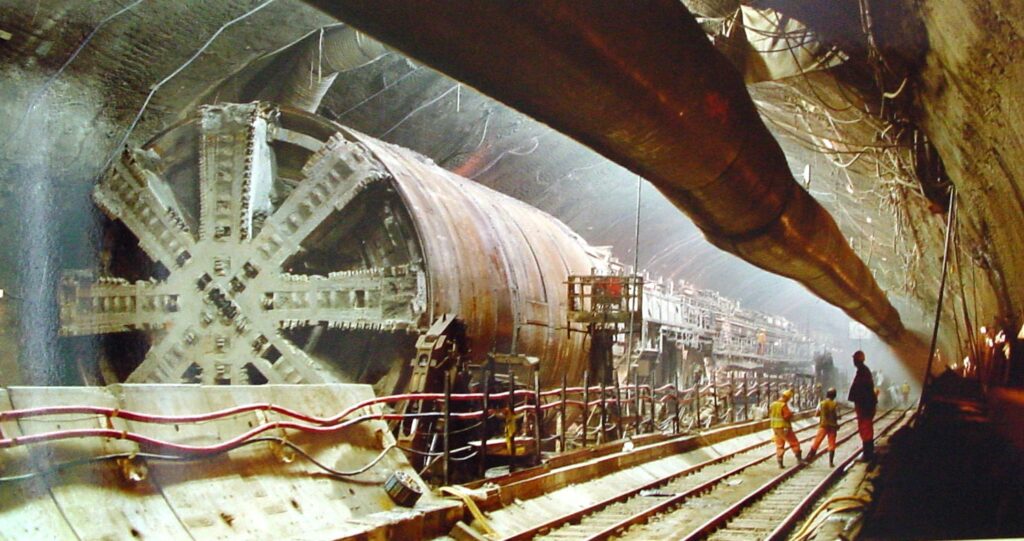
A modern TBM is less a drill and more a mobile underground factory — they can weigh well over 6,000 tons and stretch past 150 meters from the cutting face to the tail. At the front, a rotating cutter head studded with steel discs grinds into the rock and soil. Behind it, a conveyor hauls the excavated muck back out. And immediately behind that, the machine assembles the tunnel’s permanent concrete lining out of curved precast segments, bolting together a finished ring of wall before it inches forward and starts the next one. The machine builds the tunnel around itself as it crawls.
The cleverest part is invisible. In soft or wet ground, an earth-pressure-balance machine keeps the excavated soil in a sealed, pressurized chamber right behind the cutter head, using that muck to push back against the ground with exactly enough force to stop the tunnel face from caving inward. Too little pressure and the surface above sinks; too much and you heave it upward. Operators thread that needle continuously, hour after hour, often beneath streets full of buildings that have no idea anything is happening below them.
Keeping it Standing
Water Is Always Trying to Get In
A tunnel is a dry hole punched through ground that is, very often, soaked. Below the water table, the surrounding earth presses in with hydrostatic pressure that climbs the deeper you go — in some river crossings it exceeds several atmospheres, enough to drive water and sand straight through any weakness in the wall. Engineers fight this on several fronts at once: pressurized machines that hold the water back at the face, waterproof membranes and gasketed joints between the lining segments, and grout pumped into the surrounding ground to seal it shut. Even then, most tunnels leak a little, so they’re built with drainage channels and pump stations running quietly in the background, every hour of every day. A tunnel that stops pumping doesn’t stay a tunnel for long.
The Buildings Above Don’t Move — But the Ground Might
When you remove a tube of earth from under a city, the ground above wants to settle down into the space you left. A few millimeters is fine. The trouble starts when one corner of a building drops more than another, because that differential movement is what cracks walls and racks doorframes. So engineers predict the settlement before they dig, then watch it happen in real time — arrays of sensors on nearby buildings feed live data back to the operators, who nudge the machine’s speed and face pressure to keep movement under strict limits. On the most sensitive projects, crews can even inject grout into the soil between the tunnel and a foundation to lift a building back up as it tries to sink. It’s surgery, performed blind, on a patient that weighs a few hundred thousand tons.
Contingencies For The Worst-Case Scenario
The single most important thing a tunnel has to do is let people escape when something goes wrong — and the cautionary tale every tunnel engineer knows by heart is the Mont Blanc fire of 1999. A truck caught fire deep inside the alpine tunnel between France and Italy, and the ventilation system, instead of clearing the smoke, helped drive a wall of toxic fumes through the tube faster than anyone could run from it. Thirty-nine people died. The disaster rewrote tunnel safety around the world. Modern tunnels are now designed on the assumption that a fire will eventually happen: heat sensors and cameras that catch it early, ventilation that can reverse and extract smoke instead of spreading it, fire-resistant linings, and refuge points and escape passages spaced a few hundred meters apart so no one is ever far from a protected way out. The long rail tunnels go further still — the Gotthard Base Tunnel runs as two separate tubes connected by cross-passages roughly every 325 meters, so the neighboring tube is always standing by as an escape route. Done well, none of it is ever noticed. Done badly, it’s a catastrophe.
The Geology You Didn’t Plan For
No matter how many holes you drill, the ground keeps secrets, and the deepest tunnels collect the strangest ones. Under enough overburden, rock stops behaving like a solid and starts to squeeze — slowly flowing inward and clamping down on the machine like wet clay closing around a finger. Hit an unmapped fault and you can get a sudden inrush of water and debris that stops a project cold for months. And then there’s heat: rock gets hotter the deeper you go. The crews boring the Gotthard Base Tunnel — at 57 kilometers the longest in the world, running up to 2,300 meters beneath the Swiss Alps — hit rock temperatures around 46 degrees Celsius and had to run enormous cooling plants just to keep the working face survivable. That single project moved roughly 28 million tons of excavated rock and took about 17 years to finish. The deeper you go, the more the earth reminds you that it was never meant to have a hole in it. This is the part of tunneling nobody fully solves. You manage it, you plan for it, you keep contingency money in the budget — but the ground always keeps a few surprises in reserve.
CONCLUSION
Here’s what it comes down to: the next time you drive into a tunnel and come out the other side — dry, breathing clean air, the radio kicking back in and the daylight returning like nothing happened — that ease is the product of an enormous, invisible effort to make sure nothing happens.
Somewhere in the history of that tunnel is a stack of borehole logs that told an engineer what the ground was made of. There’s a machine that crawled through that ground for years, balancing the pressure at its face to keep the street above from cracking. There’s a ventilation system, sitting silent, ready to reverse itself the instant it smells smoke. There’s a pump running right now, somewhere beneath your tires, quietly keeping the river out.
None of those engineers will get a tunnel named after them. Most people couldn’t tell you a single thing about how the tunnel they use every day was built — or that “built” is even the right word for carving a permanent hole through living rock. But that work is the only reason the hole is still a hole, and not a collapse, a flood, or a headline.
The mountain wants to close back up. The engineers are the reason it doesn’t.
Sources
“Gotthard Base Tunnel.” Encyclopædia Britannica, www.britannica.com/topic/Gotthard-Base-Tunnel. Accessed 30 June 2026.
“How a Tunnel Boring Machine (TBM) Works.” Engineer Fix, 8 Nov. 2025, engineerfix.com/how-a-tunnel-boring-machine-tbm-works/. Accessed 30 June 2026.
“On This Day, Forgotten Disasters: Mont Blanc Tunnel Fire.” Fire Industry Association, 24 Mar. 2024, www.fia.uk.com/news/blogs/on-this-day-forgotten-disasters-mont-blanc-tunnel-fire.html. Accessed 30 June 2026.
“Tunnel-Boring Machine: How Does It Work, Types and Requirements.” Ferrovial, 9 Dec. 2022, www.ferrovial.com/en/stem/tunnel-boring-machine/. Accessed 30 June 2026.
“Tunnel Vision.” National Geographic, www.nationalgeographic.com/magazine/article/alps-railway-tunnel. Accessed 30 June 2026.